Introduction
The global technology industry is experiencing a major financial shake-up in 2026. Some of the world's biggest technology companies are facing investor pressure, rising infrastructure costs and concerns about the profitability of Artificial Intelligence (AI).
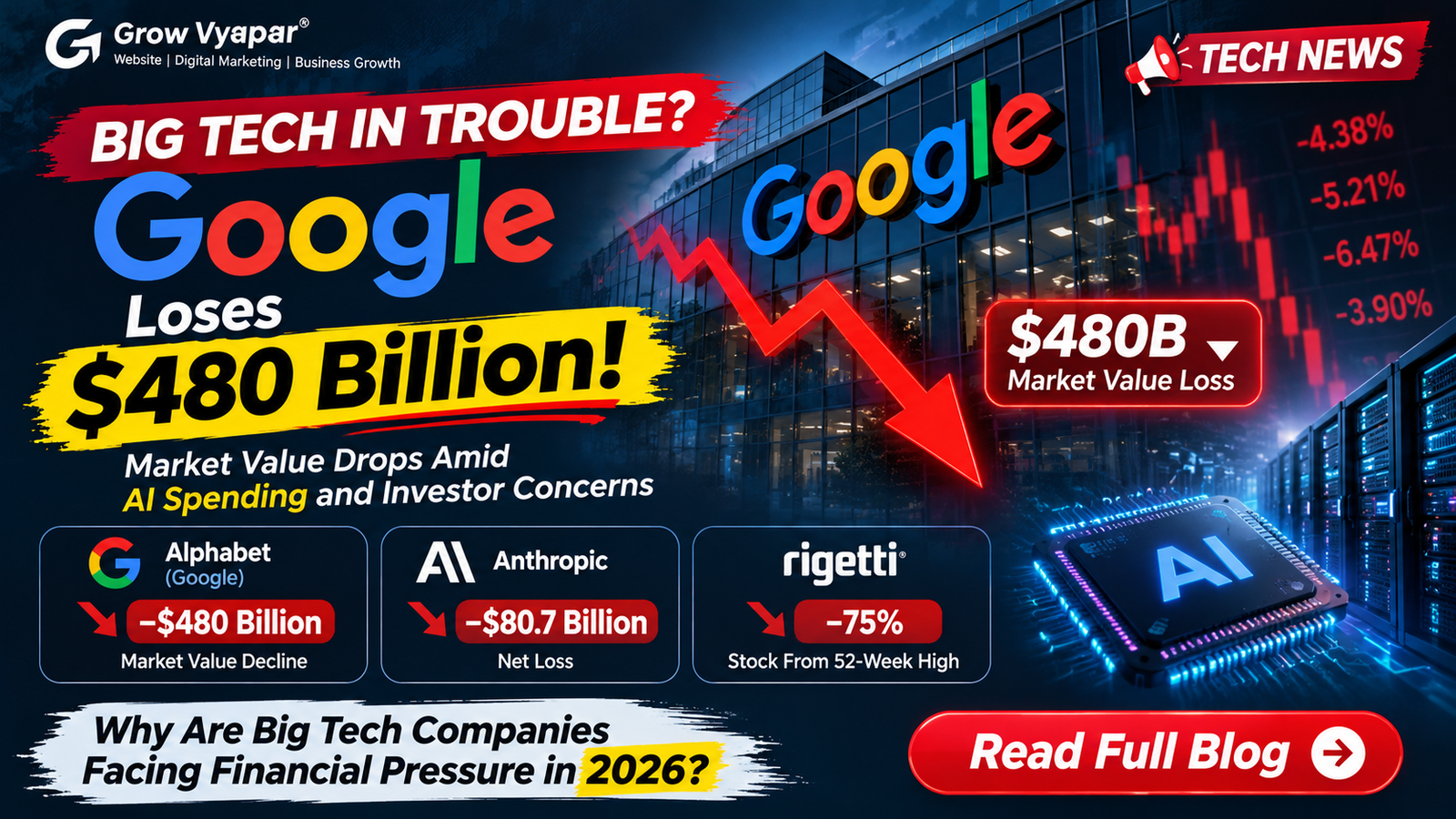
One of the biggest headlines came from Google parent company Alphabet, which reportedly lost approximately $480 billion in stock-market value in a single trading session on October 29, 2026.
But Google is not the only technology company facing financial challenges.
AI companies, cloud computing providers and emerging technology businesses are also dealing with increasing costs and changing investor expectations.
This raises an important question: Is the AI revolution becoming too expensive for technology companies?
Let's understand what is happening and why these developments matter for the future of technology.
1. Google Loses $480 Billion in Market Value
Google's parent company, Alphabet, experienced a significant stock-market decline on October 29, 2026.
Following its third-quarter financial results, investor concerns about advertising growth, AI investments and future spending contributed to a sharp fall in its share price.
The reported decline erased approximately $480 billion from Alphabet's market capitalisation in one trading session.
However, there is an important distinction: Alphabet did not lose $480 billion in cash or operating revenue. This figure represents a decline in the stock-market value of the company.
What caused the decline?
Some major concerns included:
-
Search advertising revenue falling short of expectations.
-
Increasing investment in artificial intelligence.
-
Higher infrastructure and computing costs.
-
Questions about the future of traditional search advertising.
-
Investor concerns about whether AI investments will generate sufficient returns.
Despite these concerns, Alphabet reported third-quarter revenue of approximately $127.6 billion, representing 25% year-over-year growth.
Google Cloud revenue also increased by 103% to approximately $30.7 billion.
This demonstrates that the company is still growing, even as investors reassess its valuation and spending plans.
2. Anthropic Reports an $80.7 Billion Net Loss
Anthropic, the company behind the AI assistant Claude, also attracted attention following its financial disclosures.
The company reported a net loss of approximately $80.7 billion in the first half of 2026, according to reporting on its financial filings.
However, this number requires context.
A substantial portion of the reported loss came from accounting charges associated with changes in the value of convertible notes and other financial instruments.
It should not be interpreted as $80.7 billion of cash spent on daily operations.
Anthropic is also planning significant investments in computing infrastructure to support its growing AI business.
This highlights a major challenge for AI companies: building powerful AI systems requires enormous financial resources.
3. Rigetti Computing Faces a Major Stock Decline
Another company attracting attention is Rigetti Computing, which operates in the quantum computing industry.
Its stock reportedly declined more than 75% from its 52-week high by October 30, 2026.
The decline highlights the risks associated with emerging technology companies.
Quantum computing has enormous long-term potential, but developing commercially useful systems requires substantial investment, research and time.
Investors are increasingly evaluating whether emerging technology businesses can turn innovation into sustainable revenue and profits.
4. Why Are Technology Companies Spending So Much on AI?
Artificial intelligence is transforming the technology industry.
Companies such as Google, Microsoft, Amazon, OpenAI and Anthropic are investing heavily in:
-
AI data centres.
-
Advanced GPUs and specialised processors.
-
Cloud computing infrastructure.
-
AI model development.
-
Research and development.
-
Energy and cooling systems.
-
AI-powered business applications.
Building and operating advanced AI infrastructure is expensive.
Companies must invest in hardware, electricity, data centres and skilled professionals before generating sufficient returns from their AI products.
The challenge is not simply developing better AI technology. It is developing technology that can generate sustainable profits.
5. Is AI Becoming a Financial Risk for Big Tech?
AI offers significant opportunities, but it also creates financial risks.
Consider the following challenges:
1. Infrastructure costs
Running advanced AI models requires powerful computing resources and expensive infrastructure.
2. Competition
Technology companies are competing to develop faster, smarter and more affordable AI systems.
3. Changing customer behaviour
Users are increasingly exploring AI-powered search and assistants, potentially changing traditional internet advertising models.
4. Uncertain returns
Companies are spending billions on AI development, but the long-term financial returns are still uncertain.
5. Investor expectations
Investors expect technology companies to demonstrate that their AI investments can produce sustainable business growth.
6. What Does This Mean for Small Businesses?
While major technology companies are dealing with billion-dollar investments and market fluctuations, small businesses can also learn important lessons from these developments.
AI is creating new opportunities for businesses of every size.
Small businesses can use AI tools to:
-
Automate customer support.
-
Generate marketing content.
-
Improve lead generation.
-
Manage business enquiries.
-
Analyse customer behaviour.
-
Improve website performance.
-
Reduce repetitive administrative work.
However, businesses should avoid investing in technology simply because it is trending.
The best approach is to identify business problems and choose technology that provides measurable value.
7. The Future of Technology: Innovation or Financial Pressure?
The technology industry is entering a new phase.
Artificial intelligence, automation, cloud computing and advanced hardware are changing how companies operate.
However, innovation alone does not guarantee financial success.
Companies must balance research, infrastructure spending, customer acquisition and profitability.
The next few years will reveal which businesses can turn their AI investments into sustainable competitive advantages.
Conclusion
The reported $480 billion decline in Alphabet's market value, Anthropic's substantial accounting-driven net loss and Rigetti Computing's stock decline highlight the financial uncertainty surrounding parts of the technology industry.
However, these developments do not mean that technology or artificial intelligence is failing.
Instead, they demonstrate that innovation comes with financial risks, intense competition and high expectations.
For businesses, the real opportunity is to use technology strategically rather than blindly following trends.
The future will not belong only to companies that invest the most in technology. It will belong to companies that use technology efficiently to create real business value.
At Grow Vyapar, we believe that digital transformation, website development, digital marketing and intelligent automation can help businesses build a stronger digital presence and compete in an increasingly technology-driven world.
Frequently Asked Questions (FAQs)
1. Why did Google lose $480 billion in market value in 2026?
Alphabet shares declined sharply on October 29, 2026, following investor concerns about earnings, advertising performance and increasing AI infrastructure spending.
2. Did Google actually lose $480 billion in cash?
No. The reported amount represents a reduction in stock-market capitalisation, not an actual cash loss.
3. Why did Anthropic report an $80.7 billion loss?
A substantial portion of the reported net loss was attributed to accounting charges involving financial instruments, rather than ordinary operating expenses.
4. Is AI investment becoming too expensive?
AI development requires substantial spending on computing hardware, data centres, energy and research. Whether these investments generate sufficient returns remains an important question.
5. Which technology companies are facing financial pressure in 2026?
Alphabet, Anthropic and Rigetti Computing have recently attracted attention for different financial challenges, including stock-market declines, accounting losses and investor concerns.
6. Will AI replace traditional businesses?
AI is more likely to transform many business processes than eliminate every traditional business. Companies that adopt useful technology may gain competitive advantages.
7. How can small businesses benefit from AI?
Small businesses can use AI for customer support, marketing, automation, lead generation, data analysis and operational efficiency.